Why Tech Giants and Open-Source Foundations Are Banning AI-Generated Code
Explore why Oracle, Rust, and Zig are banning AI-generated code. Discover the maintainer burnout crisis, VM security risks, and the 3 tiers of software.
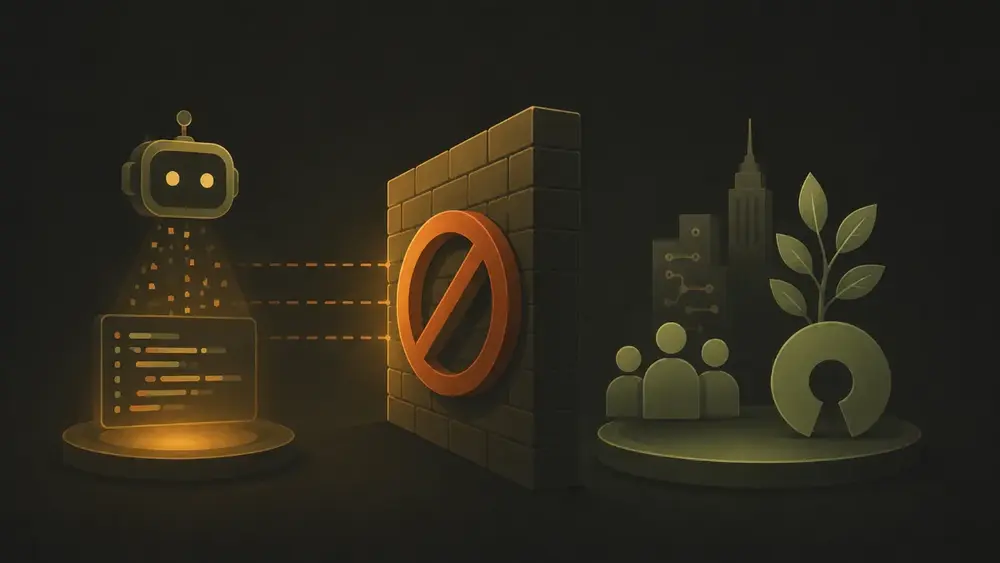
Key Takeaways (Quick Summary)
- The Great Realization: Major tech companies and open-source foundations—including Oracle (OpenJDK), Zig, and Rust—are putting up strict guardrails and outright bans against AI-generated code contributions.
- Reviewer Burnout & The AI Horde: Floods of plausible-looking LLM pull requests impose immense cognitive load on overworked maintainers who must inspect every line for subtle bugs and licensing risks.
- The Illusion of Correctness: In mission-critical runtimes like the HotSpot JVM or OS kernels, "code that looks correct" is dangerous; subtle concurrency and memory errors propagate catastrophic failures downstream.
- The Three-Tier Software Future: The industry is stratifying into disposable internal scripts (rapid AI generation), customer-facing apps (human-owned, AI-assisted), and high-leverage infrastructure (handcrafted, zero-slop engineering).
Something fascinating is happening across the software engineering landscape. After several years of relentless hype declaring that AI agents and large language models would replace software engineers overnight, reality is setting in. Tech giants and foundation maintainers are establishing strict, heavily restricted, or outright zero-tolerance policies against AI-generated code in their core repositories.
The most striking recent example comes from Oracle. Despite cutting tens of thousands of jobs during its AI investment pivot and having executive leadership proclaim an undying love for AI-generated code, Oracle made a decisive move: AI-generated code is officially banned from OpenJDK.
Featured Snippet Bait: Tech giants and open-source foundations are banning AI-generated code due to reviewer burnout, safety risks, and intellectual property liabilities. While LLMs excel at generating code that appears correct on the surface, mission-critical systems like Java's OpenJDK, Zig, and Rust require verifiable correctness, determinism, and accountable human ownership that probabilistic models cannot guarantee.
1. The Oracle Paradox: Hype Meets OpenJDK Reality
To understand why this policy shift matters, you have to appreciate the dichotomy within big tech. On corporate earnings calls, CEOs pitch autonomous coding agents as the silver bullet for engineering productivity. But in the trenches of core infrastructure, engineering leaders know the cold truth: large language models produce statistical approximations of code, not guaranteed correctness.
Oracle’s restriction on OpenJDK is remarkably precise. It does not ban developers from using tools like ChatGPT or Claude as private research assistants. Contributors can still use LLMs locally to:
- Explore and understand unfamiliar parts of the codebase
- Debug intricate problems in their personal development environments
- Brainstorm architectural approaches and review their own work
graph TD
    subgraph Allowed ["Allowed: Private Human Augmentation"]
        A["Developer"] -->|Prompt & Query| B["LLM (Claude / ChatGPT)"]
        B -->|Research & Explanation| A
        A -->|Write Original Logic| C["Handcrafted Contribution"]
    end

    subgraph Prohibited ["Prohibited: Direct Synthetic Commits"]
        D["AI Assistant"] -->|Generate Raw Output| E["AI-Generated Artifacts"]
        E -->|Direct PR, Code, Doc, Bug Report| F["OpenJDK Repository (BLOCKED)"]
    end
What contributors cannot do is copy that output and submit it back to OpenJDK. Crucially, the ban does not stop at .java or .cpp source code. It explicitly covers:
- Source code changes and pull requests
- Emails sent to project mailing lists
- Wiki documentation updates
- Bug reports and issue triage descriptions
- Synthetic diagrams and text
Oracle cites three primary drivers for this policy: Reviewer workload, Safety and security, and Intellectual property (IP) contamination.
2. Triaging the "AI Horde": The Maintainer Burnout Crisis
The first issue—reviewer workload—is the most urgent crisis facing modern open-source software engineering.
For decades, open-source sustainability depended on a simple social contract: writing code took substantial human effort, which acted as a natural spam filter. Developers had to read documentation, set up the build environment, and think through the problem before submitting a patch.
Generative AI destroyed that friction. Today, anyone can prompt an LLM to generate hundreds of lines of code without understanding a single token, slap together a pull request, and throw it over the wall to maintainers.
| Metric / Dimension | Traditional Contribution Model | The Generative AI Flood | | :--- | :--- | :--- | | Creation Effort | High (Requires research, writing, testing) | Near Zero (Prompt and paste) | | Review Effort | Moderate (Clear human intent and logic) | Extreme (Hunting for subtle hallucinations) | | Contributor Understanding | High (Author can defend design decisions) | Low to None (Author relies on AI output) | | Maintainer Impact | Sustainable ecosystem growth | Severe cognitive fatigue and burnout |
As one prominent Node.js maintainer famously phrased it, open-source triage has turned into "Triaging the AI Horde."
When hundreds of superficial PRs arrive weekly, maintainers cannot simply ignore them; what if one of those PRs accidentally patched a legitimate zero-day exploit? Reviewers are forced to painstakingly audit every line. If this dynamic continues unchecked, human reviewers will burn out completely—or worse, resort to using their own LLMs to review LLM-generated code, creating a feedback loop of unverified synthetic software.
3. The Illusion of Correctness in Core Infrastructure
Java remains one of the world's most widely deployed programming languages, consistently dominating enterprise backends, cloud runtimes, and global financial rails. OpenJDK is the reference implementation powering this immense ecosystem.
Inside OpenJDK, engineers work on:
- The HotSpot Virtual Machine and Just-In-Time (JIT) compilers (C1 / C2)
- Low-latency Garbage Collectors (ZGC, G1, Shenandoah)
- Concurrency primitives and virtual threads (Project Loom)
- Core networking, memory management, and cryptographic libraries
flowchart LR
    A["HotSpot Compiler / GC Bug"] --> B["JVM Runtime Inconsistency"]
    B --> C["Enterprise Banking & Cloud Rails"]
    C --> D["Catastrophic Downstream Outages"]

    style A fill:#f96,stroke:#333,stroke-width:2px
    style D fill:#f66,stroke:#333,stroke-width:2px
A subtle race condition or memory leak inside HotSpot will propagate downstream into millions of mission-critical systems worldwide.
This reality led Oracle to articulate the fundamental challenge of AI code generation:
"AI is very good at producing code that looks correct. Unfortunately, this is not a beauty contest, and looking correct is not one of the guarantees we generally expect from a virtual machine."
LLMs optimize for plausible-looking syntax based on training token probabilities. But systems programming does not run on plausibility—it runs on absolute mathematical correctness, cache coherence, memory safety, and deterministic invariants.
4. The Spectrum of AI Governance: Zig, Rust, LLVM, and Linux
Oracle’s OpenJDK policy is part of a broader industry-wide movement. However, different projects have adopted varying approaches across the governance spectrum:
graph LR
    Z["Zig<br><b>Total Strict Ban</b><br>No AI brainstorming, bug hunts, or code"]
    --> R["Rust<br><b>Strict Guardrails</b><br>Banned docs/diagnostics; experimental code approval only"]
    --> L["LLVM<br><b>Human Accountability</b><br>AI allowed only with 100% human verification"]
    --> K["Linux Kernel<br><b>Pragmatic Tooling</b><br>Linus: Useful for bug finding, human takes full legal/code ownership"]
The Policy Breakdown
-
Zig (Zero Tolerance): The Zig project enforces one of the strictest policies in tech. Contributors cannot submit AI-generated code, use LLMs to find bugs in Zig, or even brainstorm with an LLM and rewrite the idea in their own words. The goal is 100% pure human insight.
-
Rust (Strict Guardrails & Experimental Process): The Rust Project updated its contribution guidelines to draw clear boundaries. Private AI experimentation is permitted, but AI-generated documentation, diagnostics, and comments are prohibited. Synthetic code can only be submitted through an explicit experimental process with prior reviewer approval, thorough test suites, and mutual human understanding.
-
LLVM (Human Accountability): The LLVM compiler infrastructure permits AI-assisted contributions under one condition: a human engineer must thoroughly read, comprehend, test, and take complete personal responsibility for every single character. Autonomous agents posting unattended reviews or patches are strictly banned.
-
Linux Kernel (Pragmatic Human Responsibility): Linus Torvalds has taken a pragmatic stance, stating that Linux is not an anti-AI project. Torvalds views AI as a powerful diagnostic tool capable of identifying subtle bugs human reviewers miss. However, the Linux kernel patch guidelines require that the human submitter reproduce the issue, verify licensing compliance, rigorously test the patch, and take full liability for the change.
5. The Three Tiers of Future Software Engineering
As the initial AI gold rush matures, software development is not being replaced—it is bifurcating into three distinct tiers based on leverage and the cost of failure.
graph TD
    subgraph Tier1 ["Tier 1: Low-Stakes & Disposable Software"]
        T1["Internal dashboards, prototyping, temporary CRUD tools, proof-of-concepts"]
        T1_Action["Fast AI-heavy generation; minimal human review needed; failure has near-zero impact"]
    end

    subgraph Tier2 ["Tier 2: Customer-Facing Applications"]
        T2["Web SaaS, mobile apps, e-commerce, user workflows"]
        T2_Action["AI generates boilerplate; humans own architecture, types, tests, and observability"]
    end

    subgraph Tier3 ["Tier 3: High-Leverage & Critical Infrastructure"]
        T3["Language runtimes (JVM), OS kernels (Linux), DB engines, cryptography, banking rails"]
        T3_Action["Handcrafted engineering; zero synthetic slop; rigorous formal verification"]
    end
Tier 1: Low-Stakes & Disposable Software
Think of internal admin panels, throwaway glue scripts, marketing experiments, or single-user automations. In this tier, speed trumps perfection. If an LLM creates slightly inefficient or messy code that saves two days of manual work, the business wins. (Just ensure someone double-checks the database migration scripts!).
Tier 2: Standard Customer-Facing Applications
This represents the bulk of everyday commercial software: SaaS platforms, mobile applications, and web services. AI tools can easily generate 40% to 70% of the initial scaffolding and repetitive boilerplate.
However, human ownership remains mandatory. Engineers must write rigorous integration tests, maintain clean domain architectures, instrument comprehensive monitoring, and understand exactly how data flows through the system. You may not need to manually type every line of code anymore, but you must be able to debug it at 3:00 AM when production stalls.
Tier 3: High-Leverage, Mission-Critical Infrastructure
This tier includes compiler toolchains, database storage engines (PostgreSQL, SQLite), operating system kernels, cryptographic libraries, aviation controllers, and financial transaction settlement layers.
In this tier, an unverified assumption or subtle race condition becomes a multi-million-dollar disaster. Here, engineering standards remain uncompromising. Handcrafted code, deep mathematical reasoning, and exhaustive peer review are non-negotiable.
Conclusion: Why Handcrafted Engineering Still Matters
The recent wave of AI restrictions across OpenJDK, Rust, Zig, and Linux represents a healthy maturation of the software industry. Recognizing where AI accelerates productivity—and where its probabilistic nature poses systemic risks—is the mark of senior engineering leadership.
At the end of the day, high-leverage infrastructure requires unyielding precision. In the words of financial author Michael Lewis in Flash Boys (which brilliantly documents how subtle software mechanics reshaped global stock markets), systems with immense leverage leave zero margin for unverified shortcuts.
When building the foundational layers that the rest of the world relies on, verifiable correctness will always beat plausible-looking syntax.
FAQ (Frequently Asked Questions)
:::details Can developers still use ChatGPT or Claude when contributing to OpenJDK? Yes, but only for private, local assistance. Under OpenJDK's policy, contributors are permitted to use LLMs on their local machines to research concepts, understand complex code paths, and brainstorm debugging approaches. However, they are strictly prohibited from copying AI-generated code, documentation, bug reports, or review comments into any OpenJDK repository or mailing list. :::
:::details Why are compiler and runtime projects like OpenJDK and Zig stricter than web frameworks? Runtimes (like the JVM) and compiler toolchains underpin thousands of downstream enterprise and financial applications. A single hallucinated memory leak, broken invariant, or concurrency bug inside the JVM propagates into every application running on top of it. Because LLMs prioritize syntax plausibility rather than formal mathematical correctness, core infrastructure cannot risk unverified synthetic contributions. :::
:::details What is the main reason open-source maintainers complain about AI pull requests? The primary issue is reviewer fatigue and cognitive overload. Generating hundreds of lines of code with an LLM takes seconds for a contributor, but reviewing that code for subtle logic bugs, security vulnerabilities, and licensing compliance takes hours of deep human attention. This dynamic creates an unsustainable backlog and burns out maintainers. :::