Why Your JavaScript Build Just Got 100x Faster (And You Didn't Even Notice)
Discover how invisible Rust and Go toolchains are secretly revolutionizing JavaScript performance without changing a single line of your code.

Key Takeaways (Quick Summary)
- Invisible Upgrade: You do not need to write Rust to benefit from it—modern JavaScript tooling silently delegates heavy processing to compiled binaries via NAPI-RS.
- Multi-Threaded & GC-Free: Tools like Oxlint and Rolldown bypass JavaScript’s single-threaded and garbage-collection bottlenecks to deliver up to 100x faster execution.
- Ecosystem Consolidation: Major players like Void Zero and Cloudflare are unifying transpilers, bundlers, and linters around shared Rust parsers.
We have all been there.
You make a tiny one-line tweak to a React component, save the file, and then... you wait.
You sit back and watch a terminal spinner grind away. For a few seconds—or several agonizing minutes in large enterprise monorepos—your momentum stalls. You check your phone, grab a coffee, or switch tabs. The very developer tools designed to boost productivity end up killing your flow state.
Here is the good news: a quiet revolution has taken over the JavaScript ecosystem. While developers focus on the latest UI frameworks, the foundation under our feet is being completely replaced.
Featured Snippet Bait: Why are modern JavaScript builds so much faster? Modern JavaScript build tools are up to 100x faster because legacy Node.js tooling (like Babel, ESLint, and Webpack) is being replaced by compiled systems languages such as Rust and Go. These tools leverage multi-core parallel processing and native memory management while seamlessly integrating into npm via NAPI-RS bridges.
1. The "Spinner" Problem
Let's get one technical detail clear right away: Node.js itself is not being rewritten. Its engine remains powered by C++ and V8.
However, the peripheral ecosystem—the build scripts, linters, bundlers, and formatters—is undergoing a total overhaul. The code you write daily remains unchanged, but the engine running under the hood is now compiled Rust and Go.
[Legacy JS Tooling Stack]   ---> Slow Parsing, Single-Threaded, High GC Stalls
[Modern Rust/Go Tooling]    ---> Native Speed, Multi-Core Parallelism, Instant Warm-up
2. You Aren't Writing Rust, But You Are Running It
Here’s the beauty of this transformation: it is completely invisible.
You do not need to learn a single line of Rust syntax to reap the benefits. JavaScript remains the authoring language, while low-level compiled executables handle parsing, type checking, and optimization.
Take a look at how fast legacy JavaScript tools are being superseded across the stack:
| Tool Category | Legacy Tool | Modern Rust/Go Replacement | | :--- | :--- | :--- | | Transpilation | Babel | SWC | | Bundling | Webpack / Rollup | Turbopack / Rolldown | | Formatting & Linting | Prettier & ESLint | Biome | | Focused Linting | ESLint | Oxlint | | CSS Processing | PostCSS / Autoprefixer | Lightning CSS |
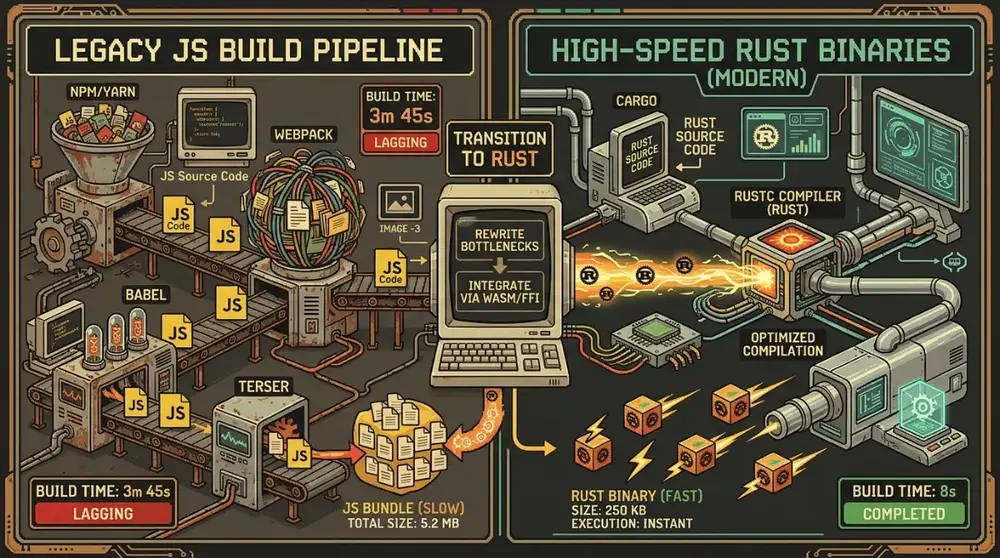
Alt Text: Conceptual graphic comparing legacy single-threaded JavaScript build tools with modern multi-core Rust and Go binaries.
How Does This Reach Your node_modules?
It all comes down to the maturity of the NAPI-RS bridge. Stable since roughly 2020, NAPI-RS enables developers to ship native C/Rust binaries packaged directly inside standard npm modules.
“The Rust is invisible. That bridge is how SWC, Rolldown, and half of this list reach you dressed up as ordinary npm packages you already install every day.”
3. The End of Single-Threaded Bottlenecks
Why is this performance jump happening right now? It comes down to a fundamental architecture mismatch between single-threaded JavaScript and modern hardware capabilities.
JavaScript runs on a single event loop. Even if your workstation packs 8, 16, or 32 CPU cores, a traditional JavaScript tool typically processes files sequentially on just one thread.
Building a modern frontend app involves a mountain of mechanical work: parsing millions of Abstract Syntax Tree (AST) nodes, rewriting references, and stitching assets together.
Single-Threaded JS (ESLint):  [ File 1 ] -> [ File 2 ] -> [ File 3 ] -> [ File 4 ]
Multi-Threaded Rust (Oxlint): [ Core 1: File 1 ] | [ Core 2: File 2 ] | [ Core 3: File 3 ]
Rust handles parallel workload distribution effortlessly. It splits up file trees and pushes them across every available CPU thread simultaneously.
Case in point: Oxlint runs 50 to 100 times faster than ESLint. A minute-long CI check collapses into milliseconds.
4. Goodbye Garbage Collection, Hello Predictable Memory
Threading is only half the story. The second hidden bottleneck is memory management.
JavaScript relies on a Garbage Collector (GC) to scan heap memory and free unused objects. In small scripts, GC pauses pass unnoticed. But when parsing multi-gigabyte ASTs with millions of transient object allocations, GC pauses produce severe lag.
Rust does away with garbage collection entirely.
- No GC Pauses: Memory is freed deterministically the millisecond an AST node falls out of scope.
- Instant Warm-Up: No JIT compilation warm-up overhead before peak execution speeds kick in.
Best of all, Rust delivers raw C-level execution speeds with a built-in safety net: the borrow checker. Low-level speed no longer requires risking memory safety exploits or segmentation faults in your build pipelines.
5. The Consolidation of the "Unified Engine"
For over a decade, web development meant chaining together dozens of decoupled tools. Today, we are entering the era of unified build engines.
Initiated by Evan You (creator of Vue and Vite) at Void Zero, the mission is clear: build a single shared Rust core for the entire web development lifecycle.
The primary performance gain here is eliminating double parsing. Instead of separate tools repeatedly converting source code into different AST representations, tools like Rolldown and Ox share the exact same underlying Rust parser.
[!NOTE] Key Ecosystem Milestones:
- Rolldown reached 1.0 in May 2025 and became the default bundler for Vite 8.
- Turbopack is now the default bundler in Next.js 16, achieving Fast Refresh speeds up to 10x faster than Webpack.
Real-world metrics prove this isn't just theoretical marketing. Tech teams at companies like Muse slashed dev server startup times from 3 minutes down to 10 seconds, while enterprise teams at Ramp halved their production build times overnight.
6. This Isn't a Hobby—It’s a Corporate "Chokepoint"
This tooling shift isn't just about developer convenience; it represents strategic infrastructure control.
In June 2025, Cloudflare acquired Void Zero, bringing Rolldown and the Ox toolchain under its enterprise umbrella.
Why does an edge computing provider care about JavaScript bundlers?
Because whoever owns the compiler toolchain controls the developer entry point to cloud deployment. To ensure fair ecosystem access, Cloudflare simultaneously backed Vite with a $1 million independence grant, securing the foundation for open web tooling.
Weekly Download Scale (2026 Metrics):
- SWC:      >40 Million downloads / week
- Rolldown: >20 Million downloads / week
Tech leaders like Shopify, Airbnb, Discord, and Mercedes-Benz now run these Rust-backed build chains in production workloads.
7. The Systems Language War: Why Go Still Wins in Some Corridors
Is Rust the only winner in this space? Not quite. The broader lesson is that compiled systems languages beat interpreted scripts for developer tooling.
Go: The Speed Demon
esbuild—written in Go—pioneered ultra-fast bundling. Building on this momentum, Microsoft released a full Go rewrite of the TypeScript compiler (tsc) in July 2026, delivering an instant 10x speed boost.
Anders Hejlsberg (creator of TypeScript) explained the choice of Go over Rust:
“TypeScript’s shared, highly mutable, pointer-heavy data structures would have fought Rust’s borrow checker at every turn. Go allowed us to preserve the core architecture while achieving raw compiled speed.”
Zig: The Runtime Experiment
Bun originally showcased the power of Zig for quick runtime execution. However, by 2026, even Bun began porting key infrastructure modules over to Rust to leverage its memory safety guarantees and crate ecosystem.
8. Conclusion: The Healthiest Kind of Change
We have officially moved past the era of using JavaScript to fix slow JavaScript tools.
This transformation represents software engineering at its best: a generational upgrade that delivers dramatic performance improvements without requiring code refactoring or breaking existing APIs.
You don't need to read Rust documentation to enjoy 100x build speedups. Just run npm update.
What Do You Think?
What is the last tool in your modern stack you still expect to see rewritten in a compiled systems language? Let us know in the comments below!
FAQ (Frequently Asked Questions)
:::details Do I need to learn Rust to use these new JavaScript build tools? No. The Rust code is compiled into native binaries and wrapped inside standard npm packages using NAPI-RS. You configure and run them using familiar JavaScript configuration files and package managers like npm, pnpm, or yarn. :::
:::details Why is Rust faster than Node.js for bundling and linting? Rust compiles directly to machine code, supports multi-threaded parallel execution across all CPU cores, and manages memory without a Garbage Collector. Node.js tools are single-threaded by default and experience execution pauses during heavy memory cleanup. :::
:::details Is Node.js being replaced by Rust? No. Node.js continues to run its V8 JavaScript engine and C++ bindings. Rust is replacing the developer tooling built on top of Node.js, such as bundlers (Webpack), linters (ESLint), and transpilers (Babel). :::