Out-of-Order HTML, Canvas DOM, and the Quiet Revolution in Web Platform Primitives
Discover Chrome's HTML streaming, Canvas DOM, and ECMAScript 2026 updates reshaping web development. Is webdev finally getting taken seriously?
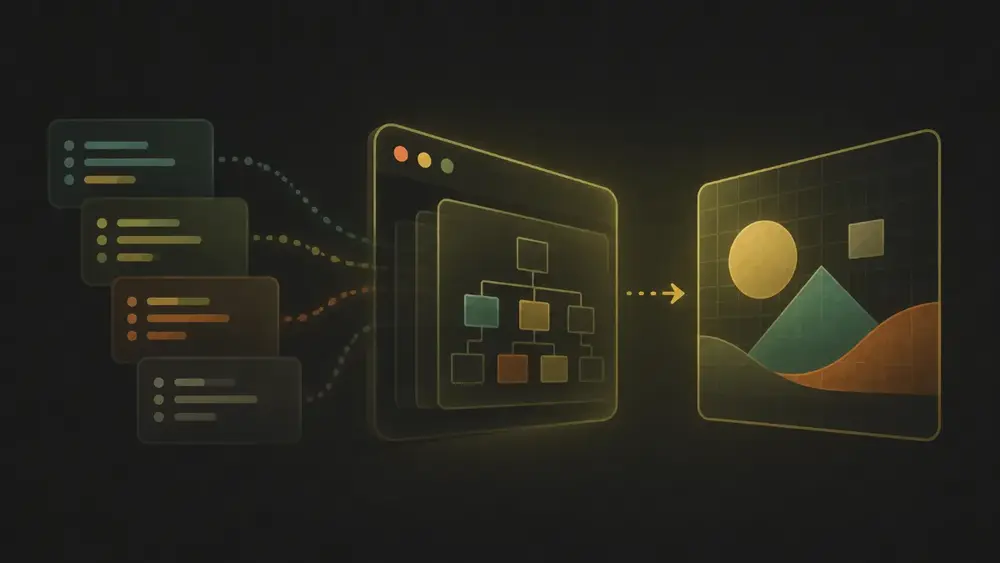
Key Takeaways (Quick Summary)
- Out-of-Order HTML Streaming: Chrome's proposal introduces processing instruction markers and a new use for the
<template>element, allowing servers to send content in any order and have the browser place it at the correct location in the DOM.- HTML Inside Canvas: An experimental Chrome API lets developers place real DOM elements inside a
<canvas>, combining pixel-perfect graphics with native browser interactions like text selection, accessibility, and form controls.- ECMAScript 2026 & TypeScript 7.0: JavaScript receives precision math utilities, iterator concatenation, and async array building, while TypeScript's native Go port delivers up to 10x faster build times.
- Framework Interoperability: These new primitives don't replace React Server Components or Astro Islands; they provide a standardized browser-native mechanism for solving fundamental rendering challenges.
The good news of the day is that a lot of great things are still happening in the webdev world. Chrome is experimenting with streaming HTML into any part of a page. HTML elements can now be rendered directly inside a canvas. JavaScript has received its yearly specification update, and TypeScript has finally completed its native rewriting.
Individually, these are interesting updates. But together, they clearly show that the lower levels of the web platform are becoming much more capable—and maybe, just maybe, webdev will actually start being taken seriously by the rest of the software industry.
Featured Snippet Bait: Chrome is experimenting with out-of-order HTML streaming, a proposal that introduces processing instruction markers and a new use for the
<template>element. This allows servers to stream content to any location in the DOM regardless of document order, providing a native browser primitive for declarative partial updates and solving a fundamental rendering problem long handled by frameworks.
1. The Streaming HTML Revolution: Out-of-Order DOM Updates
For decades, HTML has been parsed in order. The browser starts at the top of the document, processes each element sequentially, and continues toward the bottom. This works perfectly for static documents, but it becomes somewhat limiting when building modern applications.
Consider a server rendering a dashboard:
- The navigation is immediately available
- The user profile requires a quick database query
- The analytics section takes several seconds because it needs to aggregate your entire database
You can stream the page, but HTML still arrives in document order. If the analytics section appears before something that is already ready, the server either waits or sends JavaScript that inserts the missing content later.
Web frameworks are famous for coming up with sophisticated overengineered solutions to solve this problem:
- Astro has the Island Architecture
- Angular has Deferred Blocks
- React has Suspense and Server Components
- Quick has Resume/ability
While libraries like HTMX send HTML fragments that are lazily inserted into the existing document.
This is the kind of crazy stuff we devs are known for putting up with. And Chrome's proposal aims to simplify this process by moving part of this functionality directly into HTML.
How It Works: Markers and Templates
In short, we will get:
- Processing instruction markers that define where content will eventually appear
- A new use for the
<template>element that allows the server to send the actual content later in the HTML stream
When the browser encounters this template, it finds the matching marker and inserts the content there. On top of that, there are also start and end markers that can define an entire range the server can later replace.
<!-- Server sends layout first -->
<header>Navigation</header>

<!-- Marker for analytics section -->
<!--? target="analytics" -->
<p>Loading analytics...</p>

<footer>Footer content</footer>

<!-- Much later in the stream... -->
<template for="analytics">
  <div class="analytics-dashboard">
    <!-- Aggregated data here -->
  </div>
</template>
The server can send the basic page layout first, continue rendering independent sections, and deliver every component whenever its data becomes available. In other words, the position of the content in the document no longer determines when it must be sent.
We are essentially getting a browser-native primitive for out-of-order HTML streaming.
JavaScript API Enhancements
What's especially exciting—especially for developers who still like building UIs with vanilla JavaScript—is that the proposal also introduces a much more consistent family of JavaScript APIs for inserting HTML, each with a streaming equivalent.
One nice little trick we can do now is to pipe fetch responses directly into an element, and the browser can begin parsing and inserting the response before the entire payload has arrived:
// Stream HTML directly into a DOM element
const response = await fetch('/api/dashboard');
const container = document.querySelector('#dashboard');
container.appendChild(await response.html());
This does not replace React Server Components, Astro Islands, or any other architecture, since those systems handle many more concerns. But browsers and frameworks now have a standardized mechanism for solving one of their fundamental rendering problems.
2. HTML Inside Canvas: Bridging the DOM and Pixel Worlds
When building a highly visual web application, developers traditionally choose between the DOM and canvas.
The DOM gives you:
- Layout and form controls
- Text selection and accessibility
- Browser zoom and translation
- Find-in-page and autofill extensions
- All the other browser functionality we normally take for granted
Canvas, on the other hand, gives you:
- Direct control over pixels and graphics rendering
- Useful for games, design tools, diagram editors, maps
- Applications like Figma or Google Docs
But once interface elements are drawn as pixels, the browser no longer understands them. A canvas button is not really a button. As a result, you need to implement hit testing, keyboard navigation, text layout, focus management, accessibility, and every other interaction from scratch.
The HTML-in-Canvas API
The experimental HTML-in-Canvas API attempts to combine both systems. You start by placing normal HTML inside the canvas and adding the new layout-subtree attribute:
<canvas id="myCanvas">
  <div layout-subtree>
    <button id="interactiveButton">Click Me</button>
    <form>
      <input type="text" placeholder="Search..." />
    </form>
  </div>
</canvas>
The browser still treats these as real DOM elements. JavaScript can then render those DOM subtrees into the canvas. The return-transform synchronizes the real DOM element with its rendered canvas position, which allows the browser to correctly map clicks, hovering, text selection, and other interactions to the content being displayed.
Real-World Implications
The results are kind of funny because technically, you could take a normal HTML form, render it onto a surface inside a 3D scene, distort it through a shader, and still allow the user to select its text, use the inputs, or find its content through the browser's search function.
It's also worth mentioning that Three.js already has experimental support through three-html-texture, and PlayCanvas has added support through its own texture system.
3. ECMAScript 2026: Incremental Improvements, Real Impact
Stepping away from Chrome for a second, ECMAScript 2026 has also been officially approved. As usual with yearly JavaScript releases, there is no single revolutionary feature. Instead, the language receives several smaller additions that remove common pieces of userland code.
Precision Math Utilities
JavaScript is famously bad at doing math. One of the most interesting additions is Math.sumPrecise. Normal floating-point summation can lose information depending on the order of the values, but this is now solved using a new method. In the background, the engine uses a more accurate summation algorithm that avoids this intermediate precision loss.
Note, however, that this does not suddenly make 0.1 + 0.2 equal exactly 0.3. JavaScript still uses IEEE 754 floating-point numbers. The method specifically improves the process of summing an iterable of numbers.
Iterator and Array Enhancements
Other interesting additions include:
- Iterator.concat: Allowing multiple iterators to be treated as one lazy sequence
- Array.fromAsync: Building an array from an async iterable or another asynchronous source
- Map.getOrInsert and Map.getOrInsertComputed: Simplifying common map patterns
// Array.fromAsync example
const urls = ['/api/users', '/api/posts', '/api/comments'];
const data = await Array.fromAsync(urls.map(fetch));
JSON Improvements
Maps and weak maps receive getOrInsert and getOrInsertComputed. One other improvement worth mentioning is that JSON parsing and serialization become more flexible:
- JSON.parse reviver: Can access the original source text used to produce a value, making it possible to recover large integers as strings before their precision is lost
- Raw JSON: Allows a primitive value to control how it is inserted into the output of
JSON.stringify, useful when serializing values that JavaScript cannot normally represent safely as JSON numbers
4. TypeScript 7.0: The Native Rewrite Is Here
The update that was in the news recently is that TypeScript 7.0 has officially arrived, completing the compiler's native port from TypeScript to Go.
Yes, we are talking a lot about rewrites and ports these days. Once a JavaScript codebase becomes large enough, the solution is apparently to rewrite the JavaScript compiler in Go and the entire surrounding ecosystem in Rust.
Microsoft describes TypeScript 7 as roughly 10 times faster than TypeScript 6. The new compiler uses native execution, shared memory, multi-threading, and additional optimizations that generally produce build speed-ups between 8 and 12 times on Microsoft's benchmarks.
Performance Benchmarks
Compiling the VS Code codebase dropped from around 126 seconds to 10.6 seconds—a 12x improvement. Opening the VS Code project and displaying the first error fell from approximately 17.5 seconds to less than 1.3 seconds, with memory usage also decreasing across the tested projects.
The performance improvement comes partly from parallelism. Thanks to Go, TS7 can parse, type-check, and emit multiple files concurrently. There is also a single-threaded mode for constrained environments, debugging, and performance comparisons.
The Coffee Break Paradox
The irony is that just as the TS compiler gets 10 times faster, we need it less for local development. And since I mentioned coffee breaks here is your awesome trivia of the day: compiling speed-ups like this completely ruin a time-honored tradition of the software engineering industry.
In fact, if you trace it back, the entire reason we have webcams today is because a bunch of computer scientists at Cambridge in 1991 faced a catastrophic optimization problem. They were too lazy to walk down the hall for a coffee break.
The situation was grim. They worked in a multi-story building, but there was only one main coffee pot located in a place called the Trojan Room. People would routinely walk down three flights of stairs, completely context-switch, only to find the pot empty.
So, in true developer fashion, they overengineered the solution. They rigged a spare video camera to a local workstation, wrote a custom server program, and streamed a tiny 128x128 grayscale live view of the coffee pot to the internal network.
By 1993, the web finally got the ability to display images. So naturally, someone hooked the camera up to the live internet. It became one of the web's very first viral phenomena. Millions of people from around the world—who did not work at Cambridge and did not drink that coffee—tuned in just to watch a grainy, low-res pot brew in real-time in an academic basement.
5. The Convergence: A New Era of Web Platform Primitives
What's remarkable about these developments is not any single feature, but their convergence. We are witnessing the web platform itself evolve to handle problems that previously required heavyweight framework abstractions:
| Problem | Framework Solution | Native Browser Primitive |
| :--- | :--- | :--- |
| Out-of-order rendering | React Suspense, Astro Islands, HTMX | HTML streaming markers + <template> |
| Pixel-perfect + DOM hybrid UI | Custom hit-testing, manual accessibility | HTML-in-Canvas API |
| Async data composition | Redux, RxJS, custom utilities | Array.fromAsync, Iterator.concat |
| Build performance | Caching layers, incremental builds | Native Go compiler (TS 7.0) |
This convergence suggests that web development is maturing. Instead of every team reinventing the wheel with framework-specific solutions, the platform is standardizing primitives that frameworks can build upon.
The question is no longer whether webdev can compete with native or backend development. The question is how quickly the ecosystem can adopt these new capabilities and raise the bar for what we expect from the web.
6. Conclusion: WebDev's Coming of Age
Is webdev finally getting taken seriously by the rest of the software industry? These developments suggest yes.
Out-of-order HTML streaming gives us a native primitive for declarative partial updates. The HTML-in-Canvas API bridges the gap between pixel-perfect graphics and native browser interactions. ECMAScript 2026 removes common sources of userland complexity. And TypeScript 7.0's native rewrite delivers unprecedented build performance.
Together, these changes show that the lower levels of the web platform are becoming much more capable. The web is no longer just a document viewer—it is a first-class application platform.
Are you excited to try these new primitives in your projects? Have you already experimented with any of Chrome's origin trials? Share your thoughts in the comments below!
FAQ (Frequently Asked Questions)
:::details What is out-of-order HTML streaming in Chrome?
Out-of-order HTML streaming is a Chrome proposal that introduces processing instruction markers and a new use for the <template> element. It allows servers to stream content to any location in the DOM regardless of document order, solving the problem of waiting for slow data before rendering ready content.
:::
:::details Can HTML elements really be rendered inside a canvas?
Yes, through Chrome's experimental HTML-in-Canvas API. You place normal HTML elements inside a <canvas> with the layout-subtree attribute, and JavaScript renders those DOM subtrees into the canvas while maintaining native browser interactions like text selection, accessibility, and form controls.
:::
:::details What are the key features of ECMAScript 2026?
ECMAScript 2026 adds Math.sumPrecise for accurate floating-point summation, Iterator.concat for combining iterators, Array.fromAsync for building arrays from async sources, and Map.getOrInsert/getOrInsertComputed for simplifying common map patterns.
:::
:::details How much faster is TypeScript 7.0? TypeScript 7.0 is roughly 10 times faster than TypeScript 6. Microsoft benchmarks show compiling the VS Code codebase dropped from 126 seconds to 10.6 seconds, with first-error display time falling from 17.5 seconds to under 1.3 seconds. :::
:::details Do these new features replace React Server Components or Astro Islands? No. These new browser primitives provide a standardized mechanism for solving fundamental rendering problems, but frameworks like React Server Components and Astro Islands handle many additional concerns. The new features complement rather than replace existing architectures. :::