The Model Context Protocol (MCP): 5 Architecture Shifts You Need to Know
Discover how the Model Context Protocol (MCP) is solving the N×M integration problem and shifting AI workflows toward stateless architectures.
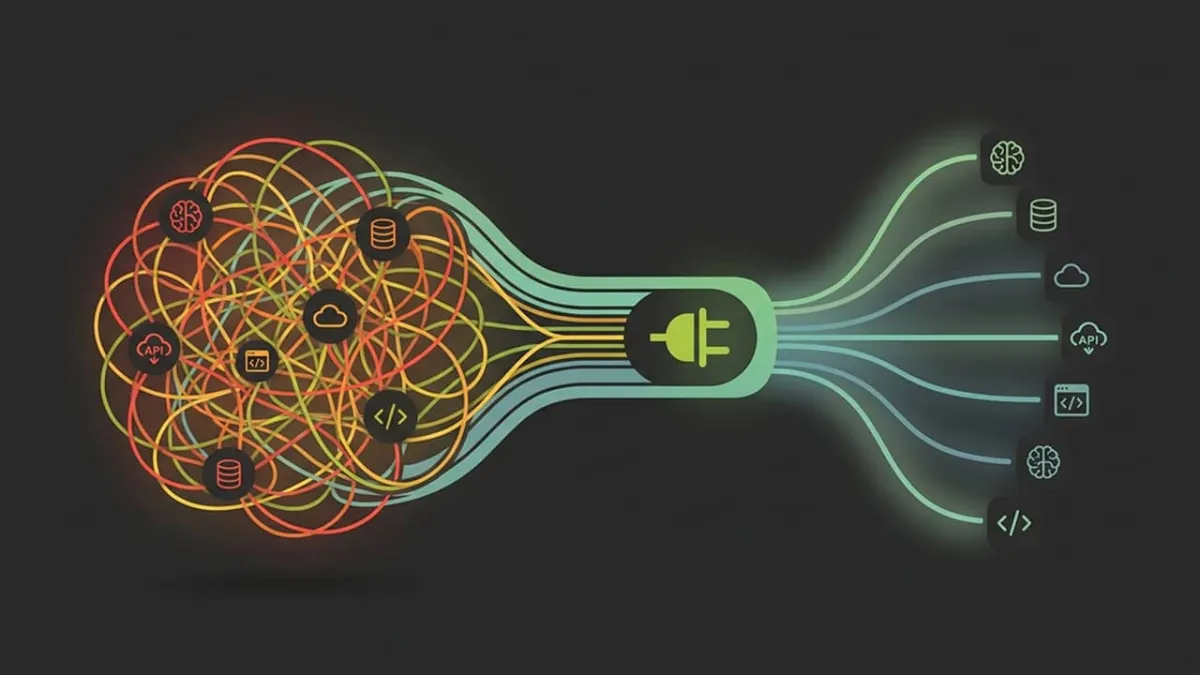
If you’ve spent any time building agentic workflows, you’ve likely stared into the abyss of the "N×M integration problem." This architectural nightmare forces every new AI application (N) to require a bespoke, custom-coded connector for every data source or tool (M) it needs to touch. It’s a brittle, unscalable approach that forces developers to waste cycles writing boilerplate "glue code" instead of innovating on the model's reasoning logic.
The Model Context Protocol (MCP) is the long-awaited "USB-C port" for the AI era. It provides a universal, standardized language that allows AI models to plug directly into databases, file systems, and SaaS APIs without a custom-coded bridge for every combination. By moving the industry toward a plug-and-play architecture, MCP is doing for AI what the standard driver did for the PC.
But as the protocol matures—specifically with the recent introduction of SEP-2567—the way we think about AI state and connectivity is shifting in counter-intuitive ways. Here are five surprising takeaways from the current state of the MCP ecosystem.
1. Shifting From Multiplication to Addition
The most transformative power of the Model Context Protocol lies in how it reframes architectural scaling. As highlighted by Databricks' analysis on AI connectivity, MCP changes the math of AI connectivity from multiplication to addition. Instead of building a unique connector for every tool-client pair, each side implements the protocol once.
This reduces the total integration effort from $N \times M$ to $N + M$. This shift isn't just a win for developer velocity; it’s the structural foundation for enterprise-grade AI.
"MCP is an open-source standardization that creates a single, unified 'language' for connecting AI models with various data sources, tools, and external applications." — Astrix Security
Standardization is the missing link for enterprise AI adoption because it fundamentally solves the vendor lock-in problem. Organizations can now build a library of internal tools that remain useful even if they switch from Claude to GPT-5 or move from an IDE-based agent to a custom internal orchestrator.
2. The Move to Stateless MCP
One of the most profound technical shifts introduced in SEP-2567 is the removal of protocol-level sessions. Historically, sessions were used to scope capabilities and application state. However, they proved brittle because different clients (like ChatGPT vs. Claude Desktop) defined "session lifetime" in conflicting ways—some per tool call, some per application launch.
By moving to a stateless protocol, MCP achieves a massive performance win for agentic orchestrators. In a session-based model, list-endpoints (like tools/list) are often session-dependent, meaning they must be re-verified for every ephemeral subagent. This creates an $O(\text{subagents} \times \text{servers})$ bottleneck.
In a stateless model, these list-endpoint results are session-independent and thus cacheable across the orchestrator’s entire lifecycle, reducing the overhead to $O(\text{servers})$. When an orchestrator can fetch a tool list once and share it across 100 short-lived subagents at zero additional cost, the latency of complex, parallel agentic workflows drops significantly.
3. Dodging the "Stdout Pollution" Trap
For developers implementing the stdio transport—the default for local processes—there is a dangerous technical "gotcha" regarding the JSON-RPC stream. Because the client spawns the server as a child process and communicates via stdin and stdout, the transport requires a pristine stream of valid JSON.
The trap is simple: rogue logs. A single console.log statement or a third-party library printing a "Connection successful" message to stdout injects non-JSON noise into the stream, causing immediate client-side parsing failures and "Unexpected token" errors.
💡 PRO-TIP: THE LOGGING FIX
- Never use stdout for logging: Use
console.error()for all debugging. Because stderr is ignored by the MCP transport layer, it is the only safe channel for human-readable logs. - Redirect stdout at startup: Forcefully redirect all standard output to a file or stderr to ensure third-party libraries don't pollute the JSON-RPC stream.
This illustrates the delicate bridge between local processes and AI models. A senior architect must treat the stdout stream as a high-integrity data bus; even one byte of rogue text can derail an entire agentic reasoning loop.
4. Explicit State Handles are the New "Shopping Cart"
With the death of the session comes a new design pattern for stateful workflows: Explicit State Handles. It is vital to understand that handles are not a protocol construct; they are a tool-design pattern. There is no schema or wire format for handles in the MCP spec.
Instead of the server "remembering" a user’s shopping cart or database transaction via an implicit session, servers now use a "create-and-thread" pattern. For instance, a server provides a tool like create_browser() that returns a browser_id. The agent is then responsible for carrying that handle as an argument in all subsequent calls (e.g., navigate(browser_id, url)).
This pattern is strictly superior for AI agents for two distinct reasons:
- Precision: A subagent can choose to share a parent's
basket_idfor a joint order but create its ownbrowser_idfor a parallel, isolated research task. - Resumption: Since handles appear in tool results, they are stored in the chat transcript, allowing an agent to pick up a transaction weeks later just by reading its own history.
5. Custom Transports are the Enterprise "Secret Sauce"
While MCP provides built-in transports like stdio and SSE, enterprise architects often find they aren't enough. According to Stainless's transport integration guide, there are four key triggers for a custom transport: performance, framework integration, security, and custom protocols (like WebSockets or ZeroMQ).
The real "aha!" moment for enterprises is the ability to embed MCP into existing, proprietary messaging systems. For example, a high-security organization might route MCP through a legacy message queue to comply with internal auditing and compliance models that standard HTTP or stdio can't satisfy.
The secret sauce of custom transports is the ability to leverage the MCP tool-discovery model while keeping the data moving through sanctioned, legacy infrastructure. It allows the enterprise to adopt the latest AI protocol without ripping out its existing security and messaging backbone.
Conclusion
We are moving away from "Static RAG"—where AI retrieves dusty, indexed snippets—and toward "Live MCP" communication. In this world, agents don't just read data; they interact with real-time APIs and authoritative systems via Model-Controlled Tools.
As agents become more autonomous, the focus shifts to governing Non-Human Identities (NHI). MCP provides the foundation for an Agent Control Plane (ACP), allowing organizations to manage the lifecycle of ephemeral AI agents from provisioning to decommissioning. By moving toward stateless, handle-based architectures, we can finally enforce the principle of least privilege on a per-action basis rather than a per-connection basis.
How is your team adapting your current API architecture to a world where model-controlled tools are the primary consumers of your data? Let us know your thoughts in the comments below!