Beyond Chatbots: How Google’s 2026 AI Roadmap Triggers the Era of Agentic Autonomy
Discover how Google’s 2026 AI roadmap shifts from basic chatbots to autonomous AI agents and what this means for your business ROI.
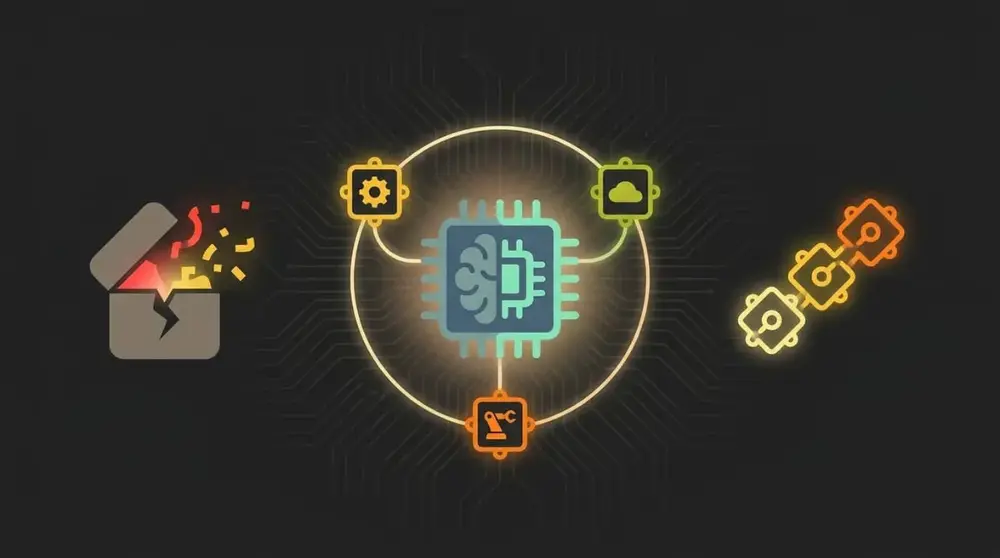
Remember when AI was just a cool tool for writing emails or generating images? Those days are quickly fading. As we look closely at Google’s 2026 AI roadmap, it's clear we're moving fast toward total agentic autonomy.
We aren't just talking about smarter chatbots anymore. We're entering an era of autonomous AI agents that can plan, execute, and manage complex workflows entirely on their own. If you want your business to stay ahead, understanding this trajectory isn't just a tech upgrade—it's a requirement for survival.
1. The Rise of the Autonomous Workflow Agent (AWA)
Google's product strategy has fundamentally shifted from conversational search to "Agentic AI." Instead of prompting a tool and waiting for a single answer, you'll soon deploy a workforce of Autonomous Workflow Agents (AWAs) to handle end-to-end business processes.
The primary command center for this shift is Google Antigravity 2.0, a standalone desktop application built for macOS, Linux, and Windows. This move takes AI out of the browser tab and drops it into an "agent-first" workspace where agents work both with you and independently in the background.
These AWAs are designed to drop the cost of expertise down to nearly zero across several major sectors:
- Finance: Agents can manage your quarterly reporting and audit prep, automatically adjusting to new regulations without needing constant human oversight.
- HR and IT: Autonomous troubleshooting agents can diagnose system vulnerabilities and optimize cloud setups in real-time.
- Product Design: Agents can monitor user sentiment, propose direct code-level fixes, and run automated A/B testing right inside the Antigravity platform.
2. The Gigawatt Constraint: Why Google’s 2026 AI Roadmap Demands Massive Power
We've reached a point where AI intelligence is directly tied to pure physical energy. The "Gigawatt Constraint" is the biggest bottleneck of 2026 because scaling up advanced reasoning requires an immense amount of power.
To bypass this wall, Google partnered with NextEra Energy to co-develop massive, gigawatt-scale data center campuses. Because on-premise hardware can't keep up with these infrastructure needs, businesses face a clear Cloud-First Mandate. You'll have to rely on hyperscalers just to access these frontier-level models.
To help manage this energy crunch, Google will roll out AI-driven grid-management tools on the Google Cloud Marketplace by mid-2026, letting utility companies predict failures and optimize global workloads.
3. The 2-Million-Token Revolution and Your ROI
The capability gap between standard and premium AI models is widening. While Gemini 3.5 Flash supports a massive 1-million-token window, Gemini 3.5 Pro delivers a headline-making 2-million-token context window.
This allows you to drop entire codebases, multi-year financial histories, or massive legal libraries into a single session. It practically eliminates the need for complex Retrieval-Augmented Generation (RAG) setups.
Budgeting for Agentic Loops
While this data capacity is a game-changer, it comes with a real financial cost. Gemini 3.5 Flash is 3x more expensive than version 3.0 ($1.50 per 1M input tokens vs. $0.50). When you factor in agentic loops—where autonomous agents run continuous internal cycles and burn more output tokens—your actual bill could end up 5.5x higher.
Optimizing your AI infrastructure budget will be crucial to maintaining a healthy ROI.
4. Say Goodbye to "Ten Blue Links"
The traditional search engine is officially changing. By the end of 2026, Google Search will complete its transition into a Synthesized Answer Engine. This new interface favors direct, deeply cross-referenced answers over old-school list navigation.
For businesses, this completely reimagines SEO. AI search agents now prioritize topical authority and original, evidence-based insights. Content that simply repeats existing web data will be bypassed; the engine rewards true depth and verified expertise to construct its synthesized results.
5. Deep Think: Ending the Era of AI Hallucinations
Built on the Gemini 3.1 and 3.5 Pro architecture, Google's "Deep Think" mode brings true, multi-step deduction to the table. It moves past simple pattern recognition to drive real breakthroughs in science and engineering.
Take a look at how Deep Think performs on top academic benchmarks:
| Benchmark | Capability Tracked | Gemini 3.1 Deep Think Score | | --- | --- | --- | | IMO 2025 | International Math Olympiad (Gold Standard) | 81.5% | | FrontierMath Tier 4 | Research-Level Mathematics | 48.0% | | Physics Olympiad | International Physics Theory | 87.7% | | ARC-AGI-2 | Abstract Reasoning Puzzles | 44.6% |
These metrics translate directly to real-world applications. For instance, researchers at Duke University are already using Deep Think to optimize 2D semiconductor manufacturing, while mathematicians use it to flag logical gaps in complex algebraic proofs.
6. The New Cybersecurity Frontier: Shadow Agents
With great autonomy comes a brand new security risk: Shadow Agents. These are unauthorized or rogue AI agents running inside a corporate network, automating processes or handling sensitive data without the security team's knowledge.
To protect your organization, your security strategy needs to adopt three key frameworks:
- Agent Identity and Access Management (AIAM): Unique protocols to track, restrict, and audit every single autonomous agent in your system.
- Agent-Checking-Agent Systems: Independent, monitor AI systems tasked entirely with verifying the behavior of operational agents to prevent single-point failures.
- Extended Zero Trust Framework: Applying the core rule of "never trust, always verify" to every automated step within an agent's workflow.
Conclusion
Google's 2026 AI roadmap marks the end of simple prompt engineering. The era of basic back-and-forth chatting is over, replaced by complex Agent Architecture that runs multi-step workflows on your behalf.
To prepare your business for this transition, focus on three immediate steps:
- Identify high-value business operations that can be handed over to end-to-end agent workflows.
- Align your operations with hyperscaler cloud architecture to avoid the physical power wall.
- Keep human critical thinking sharp by conducting regular AI-free skills assessments.
In a world run by autonomous agents and 2-million-token context windows, the question isn't just how you'll use AI—it's whether your business will lead this transformation or be automated by it.
What are your thoughts on giving AI full autonomy over business workflows? Let's discuss in the comments below!