The Invisible AI Price War: Why Gemini 3.6 Flash Is Enterprise AI’s Trojan Horse
Discover how Google's Gemini 3.6 Flash shifts AI pricing from cost-per-token to cost-per-task, slashing effective enterprise costs by up to 71%.

Key Takeaways (Quick Summary)
- The Sticker Price Is a Distraction: Real enterprise AI savings come from task completion efficiency, not raw token costs. Gemini 3.6 Flash slashes effective task execution costs by up to 71%.
- Workhorse Models Are Swallowing the Frontier: Smaller, optimized tier models like Gemini 3.5 Flash-Lite now routinely outperform older flagship engines on coding, computer use, and knowledge benchmarks.
- Agentic Efficiency Is the New Benchmark: Multi-agent parallel tool use and optimized context re-reading eliminate "tokenmaxxing," making speed and task accuracy the primary competitive edge.
The tech industry is suffering from severe frontier fatigue.
For the past two years, headlines have obsessed over a relentless arms race between colossal LLMs. Everyone fought for the crown of "most intelligent" based on deep reasoning capabilities that most production environments rarely need.
Here is the thing: the real work in enterprise AI happens in the trenches.
High-volume, repetitive workhorse models keep corporate infrastructure running. With the release of Gemini 3.6 Flash, Google is forcing developers to confront an urgent question: do cheaper tokens actually mean cheaper work?
We have hit a critical inflection point. Per-token pricing is no longer a reliable metric for enterprise value. Google is shifting the game from "bigger is better" to "smarter is cheaper"—winning the enterprise market through an invisible efficiency that most analysts are completely missing.
Featured Snippet Bait: Gemini 3.6 Flash redefines enterprise AI economics by prioritizing agentic efficiency over raw model size. By combining a 17% output price cut with up to 65% fewer output tokens per task on benchmarks like DeepSWE, it reduces total task completion costs by up to 71% while accelerating multi-agent workflows.
1. The Sticker Price Is a Distraction: Meet the Sticker-to-Task Ratio
In July 2026, Google cut the output price of Gemini 3.6 Flash by 17%, dropping from $9.00 to $7.50 per million tokens. Most commentary treated this as standard commodity repricing.
They missed the entire point.
The sticker price is the least interesting part of this update. Forward-thinking engineering teams are abandoning raw token cost in favor of the Sticker-to-Task Ratio.
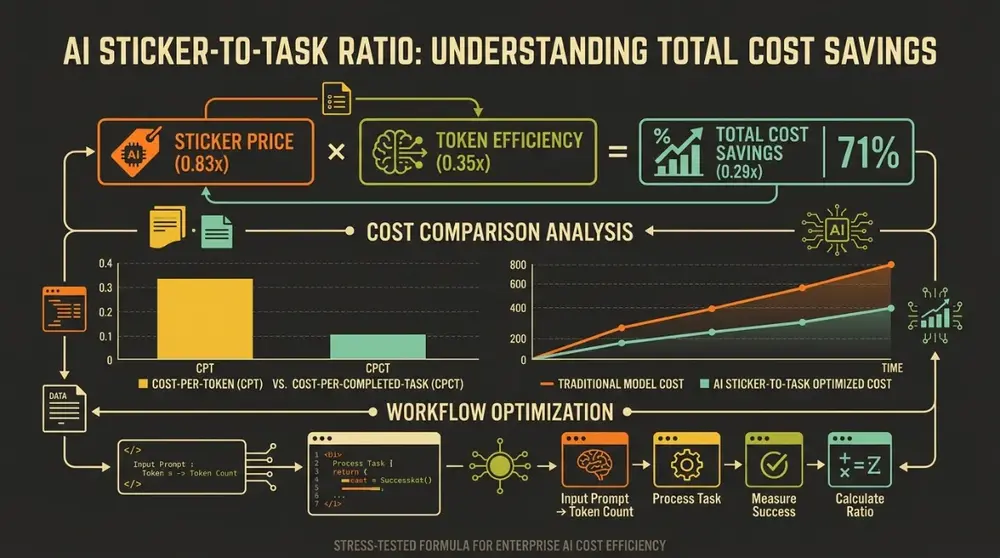
Completing complex work depends on compounding efficiency variables. Google optimized all of them simultaneously:
- Sticker Price Drop (0.83x): The direct cut to $7.50 per million output tokens.
- Token Efficiency Gain (0.35x): Gemini 3.6 Flash consumes up to 65% fewer output tokens on the DeepSWE coding benchmark.
- First-Try Success Rate: Superior instruction-following prevents expensive execution retries.
Let's break down the math: 0.83 (price) × 0.35 (tokens) = ~0.29.
That yields an incredible 71% effective cost reduction for agentic coding workloads.
As David Proctor from the Trilogy AI Center of Excellence put it, this release is "a productivity change wearing a repricing's clothes." Organizations evaluating agentic workflow metrics must immediately stop tracking cost-per-token and start measuring cost-per-completed-task.
2. The Workhorse Is Overtaking the Frontier: The Tier-Collapse Shift
We are witnessing a dramatic tier-collapse. Smaller, ultra-fast models are rapidly cannibalizing the performance metrics of legacy flagship models.
Look at Gemini 3.5 Flash-Lite—Google's entry-level throughput specialist. It now regularly outperforms previous-generation default models on critical benchmark suites:
- Coding (SWE-Bench Pro): 54.2% vs. 49.6%
- Computer Use (OSWorld-Verified): 74.0% vs. 65.1%
- Knowledge Work (GDPval-AA v2): 1140 vs. 642
Strategically, Google is positioning itself to own the exact tier where production volume lives.
While flagship models like Gemini 3.5 Pro stay locked in enterprise partner testing, Google is entrenching its Flash tier in high-frequency production pipelines. By the time the next frontier model launches, Flash efficiency will have already made it the rational default for 90% of business applications.
3. The Rise of the Gated Specialist: Enter Flash Cyber
Alongside 3.6 Flash, Google revealed Gemini 3.5 Flash Cyber, a domain-specific model integrated into their internal CodeMender platform.
Flash Cyber leverages a multi-agent orchestration architecture to detect, validate, and patch critical code vulnerabilities at massive scale.
flowchart LR
    A["Code Base"] --> B("Flash Cyber Agent")
    B --> C["Vulnerability Detection"]
    C --> D["Automated Patching"]
    D --> E("Validation Agent")
    E --> F["Verified Patch"]
This model signals an aggressive trend toward hyper-verticalized AI for high-stakes enterprise tasks.
Flash Cyber proved its horsepower by uncovering 55 unique zero-day vulnerabilities in the Chromium V8 engine. However, Google intentionally gated access, making it available only to defense entities, governments, and select enterprise partners through a closed pilot.
This highlights an emerging dual-use technology tension.
Intelligence capable of autonomously uncovering 55 zero-day flaws is deemed too dangerous for a public API. The future of specialized AI won't just be defined by raw performance—it will be governed by sovereign access and strict security clearance.
4. Agentic Efficiency: The Post-Tokenmaxxing Benchmark
The era of tokenmaxxing—flooding an LLM with endless context to force a brute-force answer—is officially over.
The new industry benchmark is agentic efficiency: generating a flawless answer with significantly fewer reasoning loops.
Gemini 3.6 Flash achieves this through native support for parallel tool execution and configurable reasoning depth. In real-world multi-agent loops, an agent might invoke tools dozens of times. Taking fewer steps directly slashes input-side spend, because every redundant turn requires re-reading the entire accumulated conversation history.
Matt Colyer, Director of Product at Figma, noted that Gemini 3.6 Flash hits a crucial operational balance:
"It hits a sweet spot, offering a much faster way to explore and iterate on prototypes while upholding the quality of designs."
The value is no longer stored inside the token itself. It lives in the speed and surgical precision with which the model navigates a complex agent loop.
5. Conclusion: Winning the Task-Completion War
Google has already confirmed pre-training for Gemini 4, but the real war for enterprise dominance isn't happening in future lab announcements. It is happening right now in the Flash tier.
While competitors chase headlines with massive parameter counts, Google is winning the race to the bottom of cost-per-completed-task.
This release serves as a stark warning for engineering leaders auditing their AI infrastructure: if your API bill drops by 20% next month, do you know why? Was it because your provider dropped token rates, or because your agents finally learned how to work smarter?
What metrics are you using to evaluate agentic AI efficiency in your stack? Drop your thoughts and benchmarks in the comments below!
FAQ (Frequently Asked Questions)
:::details How does Gemini 3.6 Flash achieve a 71% cost reduction if the price only dropped 17%? The effective cost reduction combines the 17% sticker price drop with a 65% reduction in output tokens required to complete complex tasks (such as code generation on the DeepSWE benchmark). When multiplied together (0.83 × 0.35), the cost to complete the same unit of work drops to ~29% of its previous total. :::
:::details What is the Sticker-to-Task Ratio in AI pricing? The Sticker-to-Task Ratio is a financial metric that calculates total task execution cost rather than per-token cost. It factors in sticker price per token, output token efficiency, and first-try task success rates to determine the true cost of completing enterprise work. :::
:::details Why is Gemini 3.5 Flash Cyber restricted to pilot access? Flash Cyber is a security-specialized model capable of discovering zero-day vulnerabilities (such as 55 unique flaws identified in the V8 engine). Due to dual-use security concerns, access is gated to prevent misuse while offering sovereign defense capabilities to verified partners. :::