The 36-Year Jail Sentence: Why We Still Can’t Escape Microsoft Office (and How to Finally Break Out)
Discover why Microsoft Office lock-in persists after 36 years, the OOXML standard trap, and how open source offers a blueprint to reclaim our data.
Key Takeaways (Quick Summary)
- The 36-Year Stretch: Since 1990, proprietary document formats have locked organizations into Microsoft’s ecosystem, creating a planet-sized vault of incompatible data.
- The Standard Subversion: Microsoft bypassed open standards by defaulting to the "Transitional" variant of OOXML, keeping third-party tools from rendering documents with 100% fidelity.
- A Blueprint from the Browser Wars: Open-source rendering engines (like WebKit) broke the Internet Explorer monopoly. A similar unified rendering engine is needed for document formats.
- Digital Sovereignty at Risk: Developing nations like Kenya spend billions on licenses, unable to migrate to open-source alternatives due to high-stakes formatting failures.
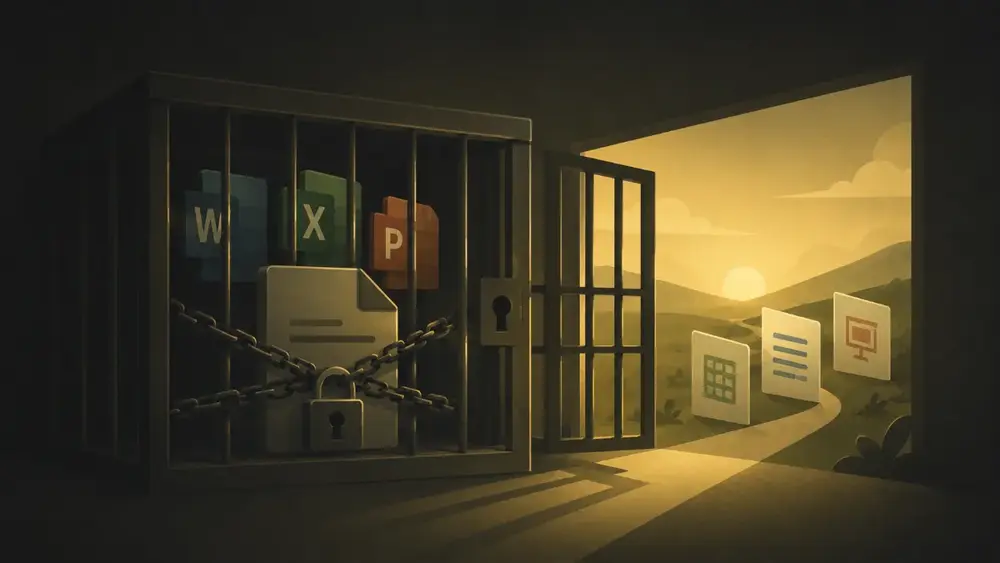
Have you ever tried moving a complex Word document to an open-source editor, only to watch the formatting disintegrate? This frustrating experience highlights the persistence of Microsoft Office lock-in. Since 1990, users have been serving a 36-year stretch—a sentence normally reserved for severe crimes. Over nearly four decades, we have unwittingly constructed an invisible prison out of our own documents, spreadsheets, and presentations. We are effectively locked behind bars built from our own data, serving a life sentence for simply trying to save a file.
Here is the thing: the central irony of our digital age is that while the internet was built on open protocols, our most critical institutional knowledge remains trapped in a proprietary vault. Even today, there is no clean escape. For policy analysts and advocates alike, the frustration is constant. Moving a non-trivial Word document out of the Microsoft ecosystem remains ugly, expensive, or inconsistent. Despite the veneer of modernization, we are still struggling with the same fundamental lock-in that existed in the era of floppy disks.
Featured Snippet Bait: We cannot escape Microsoft Office lock-in because Microsoft uses a proprietary, non-standard implementation of document formats (OOXML). This ensures that third-party open-source suites cannot render complex documents with 100% fidelity, making migration too risky and expensive for enterprises and governments that require absolute document consistency.
1. The Real Cost of a Systemic Interoperability Failure
The problem isn't just a matter of convenience; it is a systemic failure of interoperability. For any enterprise or government, migrating away from the Microsoft ecosystem is almost impossible to do with 100% fidelity. When formatting breaks, macros fail, or legal contracts lose their pagination, the cost of "freedom" becomes too high to pay.
But wait, there's more: this isn't just an inconvenience.
This is the "short leash" that keeps the world’s data tethered to Redmond, ensuring that the proprietary status quo remains unchallenged. To understand how we got here, we have to look at the mechanics of the file formats themselves.
2. The Transitional Variant Trap: The Standard That Isn't
In theory, the jail doors should have swung open in 2008 when the Office Open XML (OOXML) specification was standardized as ISO/IEC 29500. However, as any technology advocate will tell you, a standard is only as good as its implementation. Microsoft secured this status through a grueling process that resulted in a strategic bifurcation:
- The "Strict" variant: Intended to be the clean, open future.
- The "Transitional" variant: A version cluttered with legacy, proprietary quirks.
The catch? Microsoft has consistently defaulted to the Transitional version.
The Document Foundation's compatibility reports correctly identify this as a strategic subversion of the standard's intent. By sticking with the transitional variant, Microsoft ensures that what its software renders is dictated by its own proprietary choices rather than a universal, predictable set of rules. This allows for "nominal compliance" with international regulations while maintaining a practical monopoly on how files are viewed and edited.
Let's break it down: Redmond's gonna Redmond (RGR).
In the shorthand of policy analysts, "RGR" describes the inevitable tension where proprietary revenue will always be prioritized over true user freedom. By maintaining control over the rendering process, Microsoft ensures that third-party suites remain second-tier alternatives. They simply cannot guarantee the perfect fidelity required by high-stakes enterprise environments.
3. The Monopoly Playbook: From Browser Wars to Document Formats
This struggle is a direct echo of the mid-1990s. In 1995, Bill Gates issued his famous Internet Tidal Wave memo, recognizing that the open internet was a direct threat to his company’s dominance. His strategy was to "freeze out" other browsers by bundling Internet Explorer with Windows and aggressively pushing Windows-only services that only IE could consume.
While Microsoft successfully locked in the enterprise desktop, it ultimately lost the war for the internet. Why? Because open source provided a superior, faster blueprint for evolution.
The victory of open-source rendering engines like WebKit and Blink was so absolute that even Microsoft was forced to surrender, transitioning its own Edge browser to the Chromium architecture in 2020. This historical precedent offers the exact strategic blueprint we need to break the document format monopoly.
Here is why open source won the browser wars:
- Rapid, Neutral Evolution: Open protocols evolved at the speed of the internet, unburdened by the weight of a specific corporate revenue model.
- Scale Without Tax: Open-source servers and networking could be deployed globally without the friction of constant licensing fees.
- Universal Rendering Standards: The industry coalesced around shared engines (WebKit/Blink) that out-innovated proprietary lock-in machines, creating a standard that rendered perfectly across any device.
4. Kenya’s Digital Sovereignty Crisis: The Fiscal Cost of Lock-In
While the browser wars were won in the West, the document format war is currently being lost in the developing world. In these regions, digital sovereignty is a fiscal necessity rather than a luxury.
Consider Kenya: the national government and its 47 county administrations spend billions of Kenyan Shillings (KES) annually on proprietary licenses for Microsoft Office 365 and Windows. This represents a massive, recurrent drain on national budgets. These funds could otherwise support local developer ecosystems and sovereign digital infrastructure.
Kenya ICT Authority's open-source migration initiative has repeatedly attempted to migrate civil servants to open-source alternatives like LibreOffice enterprise deployment guides, only to be stopped by the "compatibility roadblock." Government departments cannot risk the technical or legal fallout of sending misformatted budget spreadsheets to the Treasury or broken legal filings to the Judiciary. In these high-stakes environments, a shifted margin or a missing font isn't just an aesthetic issue—it's a potential legal catastrophe. This fear of document corruption effectively forces these institutions back into the proprietary fold, sacrificing sovereignty for the sake of stability.
5. The Battle for Ground Truth: Building a Universal Rendering Engine
The failure to break this monopoly isn't for a lack of code. We already have dozens of OOXML engines written in everything from C++ to Rust. However, fragmentation is the enemy of a standard.
We don't need more engines. We need a unified, bulletproof open-source rendering engine—an "Office equivalent to WebKit or Blink."
The primary technical requirement for such an engine is a comprehensive, industry-backed test suite. This suite must be capable of tracking the "ground truth" of how Microsoft’s products actually behave as they evolve. Microsoft continuously updates its implementation to keep the "short leash" tight; our counter-strategy must be a suite that accounts for proprietary dependencies like specific fonts.
The "font problem" is a perfect example of how lock-in is maintained: when a document relies on a proprietary font not available in an open-source suite, pagination shifts, ruining the integrity of legal filings and government reports. A unified engine, backed by a rigorous test suite, would ensure that an open-source tool's output matches the proprietary source with 100% fidelity, finally removing the risk associated with migration.
Conclusion: Reclaiming Global Institutional Knowledge
Breaking the OOXML monopoly is a fundamental prerequisite for global digital sovereignty. Until nations and organizations can truly own their data without fear of corruption, they remain mere tenants in a proprietary system. The path forward requires a well-funded industry coalition dedicated to building a universal rendering standard—a "final blow" to the document lock-in that has persisted for 36 years.
We have seen open source dismantle monopolies before by focusing on superior, universal tools. It is time to apply those lessons to the very documents that house our global history.
How much longer are we willing to keep our global institutional knowledge stored in a proprietary vault? Let us know your thoughts in the comments below.
FAQ (Frequently Asked Questions)
:::details What is the difference between the "Strict" and "Transitional" variants of OOXML? The "Strict" variant of Office Open XML is the clean, ISO-standardized version designed for open interoperability. The "Transitional" variant is a Microsoft-specific version that includes legacy, proprietary quirks, which Microsoft defaults to in order to maintain its ecosystem lock-in. :::
:::details How can open-source tools solve the Microsoft Office formatting compatibility issue? To solve formatting compatibility, the open-source community needs a unified rendering engine (similar to WebKit for browsers) backed by a comprehensive test suite that tracks the "ground truth" of Microsoft's software behavior, including handling proprietary font dependencies. :::