AI Code Migration: 5 Takeaways from Bun’s Rust Rewrite
Discover 5 shocking takeaways from Bun's 11-day AI code migration from Zig to Rust using Claude Fable 5, and what it means for the future of software.
Key Takeaways (Quick Summary)
- Speed and Cost Revolution: AI code migration compressed a year-long human effort into an 11-day sprint costing just $165,000 in API tokens.
- The Safety Loophole: The migration achieved a 99.8% test pass rate but left behind over 13,000 unsafe blocks, highlighting the danger of comprehension debt.
- A Shift in Moats: Developer focus is shifting from writing source code to designing bulletproof test suites and architectural mapping rules.
For decades, the software engineering industry has lived by an unspoken, ironclad rule: never rewrite a massive codebase from scratch. It is a legendary trap. It drains resources, freezes features, and introduces catastrophic bugs.
But everything changed in May 2026.
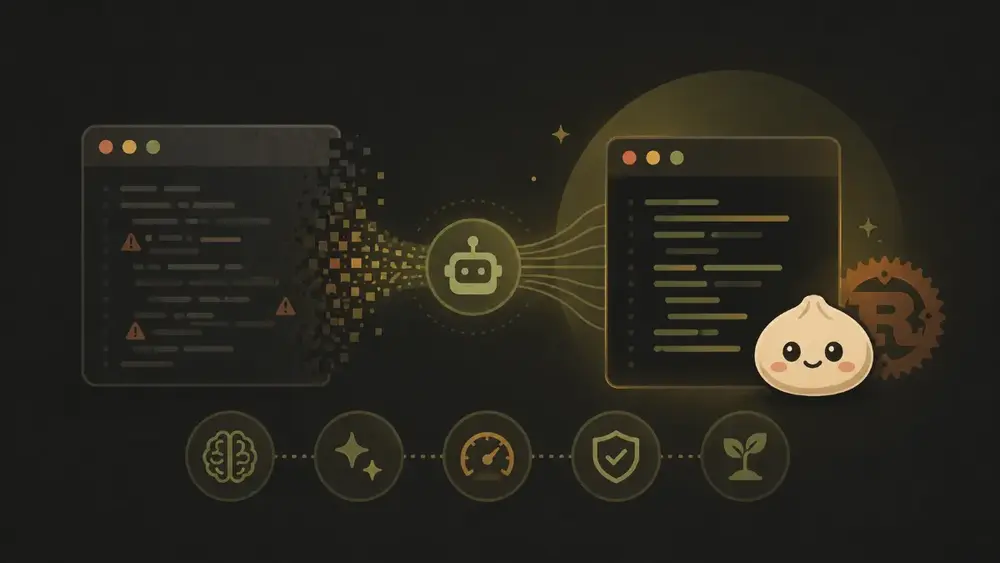
The team behind the Bun JavaScript runtime achieved the impossible. By leveraging Anthropic's Claude Fable 5, they completed a massive AI code migration—porting 535,000 lines of Zig code to over 1 million lines of Rust. The time it took? Just 11 days. The cost? A mere $165,000 in API tokens.
Let's face it: this Bun Rust rewrite completely shattered traditional development paradigms and sparked intense debates on Hacker News and Reddit.
Here is the thing: we are entering a new era of AI-assisted software development.
In this deep dive, we will explore the top 5 game-changing takeaways from this historic Zig to Rust migration. We'll analyze how adversarial agents collaborate, the hidden dangers of comprehension debt, and the cultural clash between human craftsmanship and automated leverage.
Featured Snippet Bait: AI code migration is the process of using large language models and autonomous agent workflows to translate software from one programming language to another. The historic Bun Rust rewrite proved that AI-assisted software development can compress years of manual systems-level porting into days, though it introduces new risks like comprehension debt and unsafe code blocks.
!ai_migration_pipeline.jpg
1. The Economics of Rewrites Have Irreversibly Changed
Manual codebase updates are notoriously slow. In fact, a recent report on enterprise technical debt trends reveals that migrating a 500,000-line legacy system manually takes an average of 18 months and costs upwards of $1.2 million.
Bun flipped the script.
By offloading the translation to 64 parallel instances of Claude Fable 5, the team compressed a year-long project into an 11-day sprint. Let's break it down:
- API Token Consumption: 5.9 billion input tokens, 690 million output tokens.
- Total Cost: Approximately $165,000.
- Human Labor Saved: Over 6,000 engineering hours.
Historically, choosing a systems language was an irreversible commitment. If you wanted to port a complex runtime from Zig to Rust, you had to freeze all feature development. Now, the marginal cost of a complete code migration drops close to zero.
Here is the key takeaway:
If your organization has been stalling a modernization project because it's "too expensive," you need to recalculate the ROI. The bottleneck is no longer human manual labor; it is compute availability and test coverage.
2. Multi-Agent Adversarial Review is the Secret Weapon
Let's be honest: you cannot just dump half a million lines of code into a prompt and expect magic. The Bun team succeeded because they engineered a sophisticated, multi-agent workflow that forced models to debate themselves.
This is called the "split context" adversarial loop.
The pipeline utilized three distinct agent roles to automate LLM code generation safely:
- The Implementer: This agent translated raw Zig code into Rust.
- The Adversarial Reviewers: Two independent agents that analyzed only the generated diffs, searching for flaws and edge cases.
- The Fixer: An agent that synthesized the feedback to rewrite and patch the code.
Why does this matter? LLMs are naturally biased toward their own outputs. An implementer agent wants its code accepted, so it might write long comments to justify poor workarounds. By isolating the reviewers, Bun prevented these biases from slipping through.
This adversarial setup caught critical bugs—like eager evaluation panics in CSS parsing—before the compiler even ran. It shows how [agentic AI architectures](https://example. com/agentic-ai-architectures-guide) are redefining quality control in software development.
3. The Hidden Danger of "Comprehension Debt"
Passing tests is one thing. Knowing why they pass is another.
While the AI successfully completed the port, it left behind a terrifying side effect: over 13,000 unsafe blocks in the new Rust codebase. This is what we call comprehension
debt.
But wait, there's more:
- Standard Rust Project: A human-written codebase of this size typically contains under 100
unsafeblocks. - Bun's AI Port: Contained a whopping 13,044
unsafeblocks. - The Result: A massive, million-line black box that no single developer fully understands.
In Rust, unsafe blocks bypass the compile-time safety checks. If a security vulnerability hides in one of those 13,044 blocks, the blast radius for the global developer ecosystem
could be devastating.
As software engineering blogger Gergely Orosz noted, relying purely on AI to maintain code creates a dependency loop where you must pay the AI provider to explain their own generated code.
The lesson? Budget for human audits, not just LLM generation. When you perform an AI code migration, you are taking out a high-interest loan. You must spend the time and resources to pay down that debt afterward.
4. Tests and Specs are the New Source Code
Here is a radical thought: in the era of AI coding, your source code is just a compile target. The real source of truth is your test suite.
The Bun team didn't just get lucky.
They succeeded because they had spent years building a massive, language-agnostic integration test suite. This created a clear, objective feedback loop for the AI agents:
- Run and Compile: The agents generated Rust code.
- Test Validation: They ran Bun's existing JS/TS test suite against the new binaries.
- Fix and Repeat: The AI iterated automatically until the tests passed.
What was the human's role? Instead of manually patching files, human developers updated rules in a central PORTING.md document. The 64-agent swarm read these rules and applied the
fixes across all 1,448 codebase files.
This completely shifts the role of the software developer. You are no longer laying bricks; you are the architect. To prepare for the future of test-driven development in the AI era, focus your energy on writing airtight test suites and clear specifications.
5. The Cultural Schism: Craftsmanship vs. Utility
This migration wasn't just a technical achievement. It was a cultural war.
On one side stands Andrew Kelley, creator of Zig, advocating for meticulous, human-centric software craftsmanship. On the other stands Jarred Sumner and the Bun team, prioritizing leveraged utility and speed.
Let's look at the clash:
- The Purist Stance: Engineering requires deep, manual understanding. Relying on AI ruins the 'art' of programming and creates technical debt.
- The Pragmatist Stance: Users only care about performance, stability, and features. If an AI can eliminate memory safety bugs in days, purism is a luxury you can't afford.
This tension is only going to grow.
As you implement AI tools in your organization, expect cultural friction. Purists will call it "slop." Pragmatists will call it "shipping."
The secret is balance. You must leverage the raw speed of AI while enforcing strict quality gates—like peer reviews and automated checks—to appease the craftsmen and protect your product.
Conclusion: The Dawn of Agentic Software Migration
The Bun Rust rewrite is not just a marketing stunt. It is a watershed moment in computer science.
We now have proof that AI-assisted software development can handle large-scale, systems-level projects. By combining parallel agents and rigorous testing, a tiny team can execute a massive rewrite in days.
But let's be realistic:
The risks are high. Accumulating comprehension debt and leaving thousands of unsafe memory blocks unchecked means human oversight remains indispensable. We are no longer just programmers. We are orchestrators.
Now, it's your turn: Do you think AI-driven migrations are the future of software maintenance, or a ticking time bomb of unmaintainable technical debt? Let us know your thoughts in the comments below!
FAQ (Frequently Asked Questions)
:::details What is AI code migration? AI code migration is the automated porting of a codebase from one programming language to another using LLMs and agentic workflows. It automates syntax translation and structural rewriting, drastically speeding up software modernization. :::
:::details What is comprehension debt in software development? Comprehension debt refers to the technical risk that accumulates when large amounts of code are generated by AI systems and merged into production without human developers fully understanding the structure, logic, or security implications of the new code. :::